
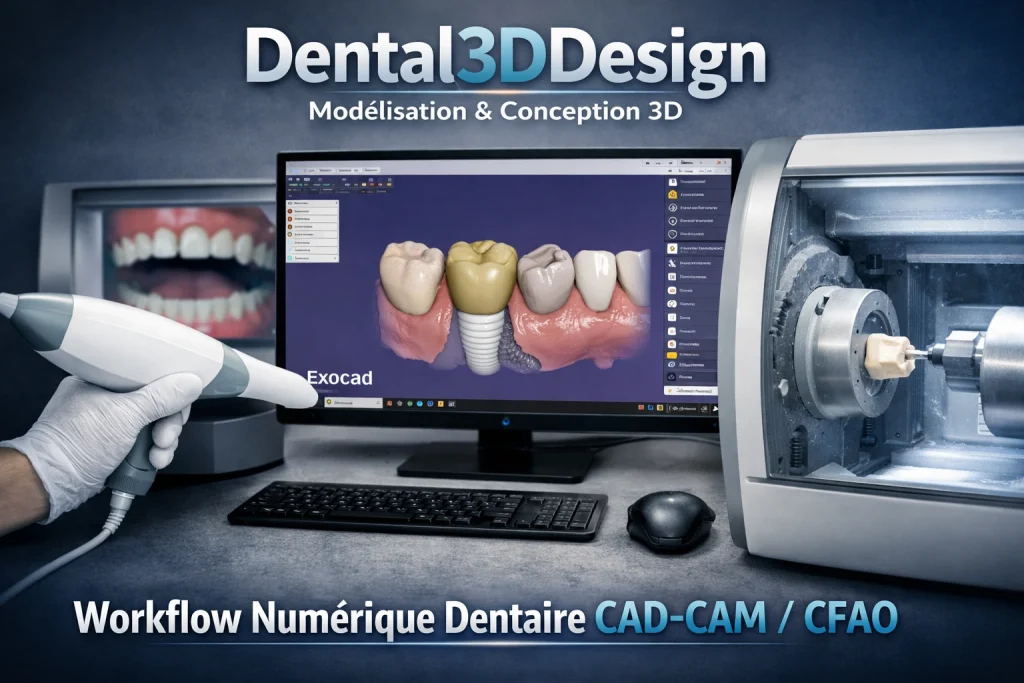
Digital workflow in dentistry: the CAD-CAM revolution for faster, more precise restorations
What is digital dental workflow?
The digital dental workflow refers to all the digital steps involved in the design and manufacture of a restoration or implant device using CAD-CAM / CAD/CAM technologies.
This workflow integrates optical impression, 3D modeling, prosthetic design and digital manufacturing.
It guarantees unrivalled precision, reduced lead times and a better patient experience.
1. Step 1: Intra-oral digital impressions
The workflow begins with an intra-oral scanner (Trios 3Shape, iTero, Medit, Primescan…) which replaces conventional impressions.
Advantages :
Maximum patient comfort
Highly accurate 3D data
Immediate detection of areas to be corrected
Instant transmission to the laboratory or 3D designer
The digital fingerprint forms the basis of a perfectly reliable digital workflow.
2. Step 2: CAD prosthetic design on Exocad / 3Shape
The scanned files are imported into digital design software such as Exocad, DentalCAD or 3Shape.
The 3D designer can create :
crowns, bridges, inlays/onlays
complete prostheses
digital wax-ups
surgical guides
All-on-4 and All-on-6 implant solutions
high-precision 3D models
Why does CAD transform prosthetics?
millimetric fit
dynamic visualization of occlusion
better aesthetic anticipation
simple communication between dentist and designer
significant reduction in chairside touch-ups
3. Stage 3: CAM manufacturing and 3D printing
After validation of the CAD design, manufacturing is carried out either by CAM machining or 3D printing.
Available technologies :
5-axis milling machines for zirconia, disilicate, titanium, PMMA
SLA / DLP 3D printers for temporaries, models, surgical guides
Advantages of digital manufacturing :
Speed (production in just a few hours)
Perfect reproducibility
Highly aesthetic results
Optimum fit in the mouth
4. Digital workflow and implantology: a major asset
In implantology, digital technology drastically improves precision and predictability.
Applications :
3D implant planning
safe guided surgery
immediate prosthesis on implants
fully digital All-on-4 and All-on-6 protocols
Thanks to these tools, each step can be simulated and validated prior to surgery.
5. Collaboration between dentist and 3D designer: the key to digital workflow
Calling on a 3D dental modeling center dental modeling center such as Dental3DDesign enables the practitioner to work faster, more serenely and with better prosthetic quality.
Benefits for the dental practice:
simplifying everyday life
time-saving at the wheelchair
reduced inaccuracies
smoother communication with the lab
standardization of prosthetic and implant results
Conclusion: CAD/CAM, an unavoidable standard
The digital CAD-CAM workflow has become indispensable for practices and laboratories wishing to offer fast, reliable and esthetic restorations.
It transforms prosthetics, optimizes implantology and enhances the patient experience.
Adopting this technology means fully embracing modern dentistry.
FAQ – CAD-CAM / CFAO digital workflow
1. Does digital workflow improve precision?
Yes, optical impression, 3D CAD design and CAM manufacturing guarantee far greater precision than traditional techniques.
2. Which intraoral scanners are recommended?
The 3Shape Trios, iTero, Medit or Primescan scanners offer seamless integration into a 100% dental digital workflow.
3. What’s the difference between CAD-CAM and CAD/CAM?
CAD-CAM and CFAO refer to the same technology: Computer-Aided Design and Manufacturing.
4. What materials can be used in CAM manufacturing?
Zirconia, disilicate, PMMA, printable resins, titanium, composites… all compatible with a modern digital workflow.
5. Is digital workflow useful in implantology?
Yes, it allows guided surgery, 3D planning and All-on-4 / All-on-6 rehabilitation with optimum precision.
6. Why outsource 3D design?
Outsourcing digital modeling saves time, reduces rework and benefits from the expertise of a 3D design specialist.